

You have seen the beds fill up. Outpatient queues stretch down the corridor. The lab runs double shifts. Business looks good on the surface.
But at the end of the month, the numbers do not add up.
Most hospitals lose between 10% and 15% of their annual revenue because of how those patients are billed, documented, and followed up on. Silent, preventable leaks that drain your cash flow while staff stays busy and management stays confused.
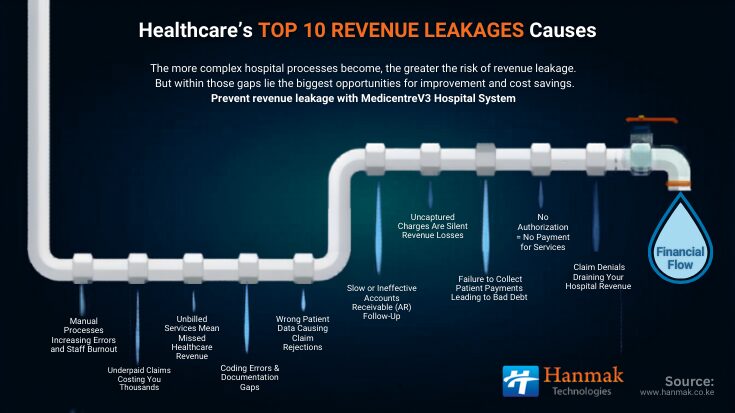
Here are the 10 biggest causes of revenue leakages in healthcare and what it actually takes to fix them.
1. Manual Processes Increasing Errors and Staff Burnout
When your billing team is hand-keying patient data, tracking claims in Excel, and chasing doctors for signatures - mistakes are not a matter of if, they're a matter of when.
Manual workflows mean duplicate entries, missed charges, and staff who spend more time correcting errors than processing new revenue. Burned-out billing staff also miss follow-ups, let claims age, and eventually leave - taking their institutional knowledge with them.
The fix: Automate patient registration, charge capture, and claims submission so your team focuses on exceptions, not routine entry.
2. Underpaid Claims Costing You Thousands
Insurance companies sometimes pay less than the agreed contracted rate and unless someone is checking, that shortfall just becomes absorbed.
Underpayments are quiet. There is no rejection letter. The claim was "paid." But at scale, a recurring KSh 500 underpayment across hundreds of claims adds up to hundreds of thousands a year in uncollected revenue.
The fix: Your hospital system should automatically flag payments that do not match contracted rates and escalate them for dispute before the claim window closes.
3. Unbilled Services Mean Missed Healthcare Revenue
A patient receives a procedure. The doctor documents it - informally, in the ward notes. Nobody raises a charge. The patient is discharged. The bill goes out without that service on it.
This happens constantly. Lab tests ordered verbally. Consumables used but not captured. Specialist consultations not tied to a billable entry.
The fix: Every service, supply, and consultation needs to flow automatically into the billing queue at the point of delivery, not hours or days later.
4. Coding Errors and Documentation Gaps
Wrong ICD or CPT codes on a claim don't just get rejected, sometimes they get paid at the wrong rate, or trigger a fraud flag that puts your account under scrutiny.
Poor documentation is the root cause. If clinical notes are vague, the billing team has to guess and guesses are wrong more often than anyone wants to admit.
The fix: Integrate clinical documentation with billing so that coders are working with complete, structured notes - not piecing together a story from handwritten scribbles.
5. Wrong Patient Data Causing Claim Rejections
A transposed ID number. A misspelled name. An outdated insurance member number. These small errors at registration become claim rejections two weeks later and by then, finding and fixing them is far more expensive than getting it right the first time.
The fix: Validate patient demographics and insurance details at check-in, not at submission. Build verification directly into your registration workflow.
6. Slow or Ineffective Accounts Receivable (AR) Follow-Up
Claims do not pay themselves. Insurers and corporates rely on the fact that busy hospitals don't follow up aggressively. The longer a claim sits unpursued, the higher the chance it gets denied, forgotten, or written off.
An AR aging report that no one acts on is just a list of money you've decided not to collect.
The fix: Automated AR workflows that flag aging claims, escalate unresolved cases, and generate follow-up tasks, so nothing falls through the cracks because someone was "too busy."
7. Uncaptured Charges Are Silent Revenue Losses
Unlike a claim rejection - which at least tells you something went wrong - an uncaptured charge produces complete silence. You treated the patient. You just never billed for part of it.
Theatre consumables. Oxygen. Medications dispensed from the ward. These are easy to miss and systematically under-billed at most hospitals.
The fix: Every department that delivers a service needs to be connected to the billing system in real time. If it's dispensed or used, it must generate a charge automatically.
8. No Authorization, No Payment for Services
Admitting a patient for a procedure that required prior authorization - and not getting it - is one of the fastest ways to turn a billable service into a write-off.
Insurers will not pay for unauthorized services. The patient often will not either. The hospital absorbs the full cost.
The fix: Pre-authorization checks need to happen at the point of admission or booking, not as an afterthought before discharge.
9. Failure to Collect Patient Payments Leading to Bad Debt
Patients leave without paying their co-pays, deposits, or final balances. Once they are out the door, collecting is exponentially harder. Some hospitals have patient receivables aging beyond 180 days at which point recovery rates drop below 20%.
The fix: Collect at the point of service. Use your system to track patient balance obligations in real time and flag accounts before discharge.
10. Claim Denials Draining Your Hospital Revenue
Denial management is where most hospitals bleed most visibly, and where most do the least. Every denied claim needs to be reviewed, corrected, appealed, and resubmitted within the payer's deadline. Without a structured process, a large portion of denied claims simply expire.
The fix: A denial tracking workflow that categorizes denial reasons, assigns them to the right person, sets deadlines, and monitors resolution rates.
Every single leakage on it has one thing in common: it happens when information doesn't move fast enough, accurately enough, or to the right person at the right time.
Paper-based hospitals leak by default. And hospitals running fragmented, disconnected software are barely better, they have just digitized the same broken processes.
What stops the leak is a fully integrated Hospital Management Information System that connects clinical care, billing, pharmacy, insurance, and administration into one real-time flow.That's exactly what MedicentreV3 is built to do