Kenya Digital Health Superhighway Explained: What Every Health Facility Needs to Know
You have probably heard the phrase "Digital Health Superhighway" in a SHA circular, a DHA meeting, or from your HMIS vendor. Here is what it actually means, without the jargon.
Imagine this: A patient's blood test results are stored in the laboratory system of one hospital. Their medical history is kept in paper files at another clinic. Their prescription records exist only in the pharmacy where they were issued. Their SHA insurance information is stored on a different platform.
Since these systems do not communicate with each other, healthcare providers often have incomplete information when treating patients. This can lead to duplicate tests, delays in treatment, and insurance claims being rejected because of missing or incorrect information.
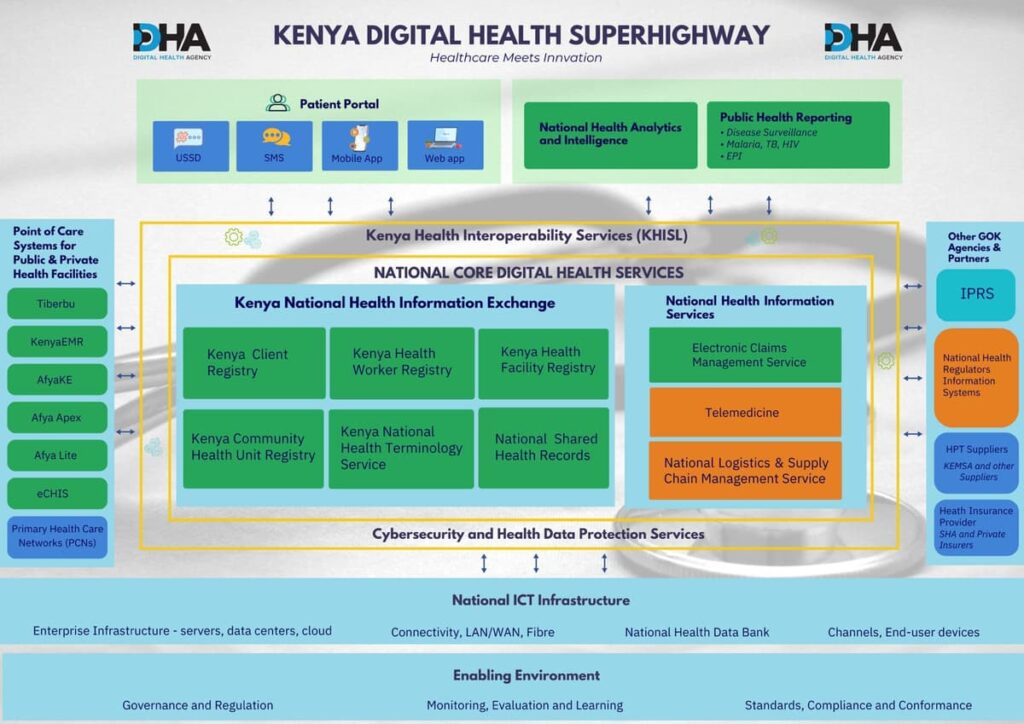
Kenya's Digital Health Superhighway was created to solve this problem by connecting healthcare systems across the country.
It is not a single application or software system. Instead, it is a national digital health network that allows health information to be shared securely between patients, healthcare facilities, insurers, government agencies, and healthcare professionals.
Developed and managed by the Digital Health Agency (DHA), the Digital Health Superhighway is one of Kenya's most important healthcare projects. Every healthcare facility should understand how it works and what it means for delivering better patient care and meeting national digital health requirements.
Who Built This and Why?
The Digital Health Agency (DHA) is a government body dedicated to transforming healthcare delivery through the integration of cutting-edge digital technologies. Its mandate is to develop, operationalize, and maintain the Comprehensive Integrated Health Information System (CIHIS) - the national digital health backbone - to manage core digital systems and the infrastructure required for seamless health information exchange.
DHA was established under the Digital Health Act 2023, the legislation that gave Kenya the legal foundation for a fully connected national health system.
The Digital Health Superhighway is the national digital health ecosystem developed by the Digital Health Agency (DHA) under its legal mandate. It brings together connected platforms that allow health information to be shared securely across the healthcare system.
The Superhighway has four main layers: Core Registries, Health Information Services, Analytics and Reporting, and Digital Infrastructure. Each layer has a specific role, and together they create Kenya's most comprehensive digital health system, improving the way health information is managed, shared, and used across the country.
Layer One: The Core Registries
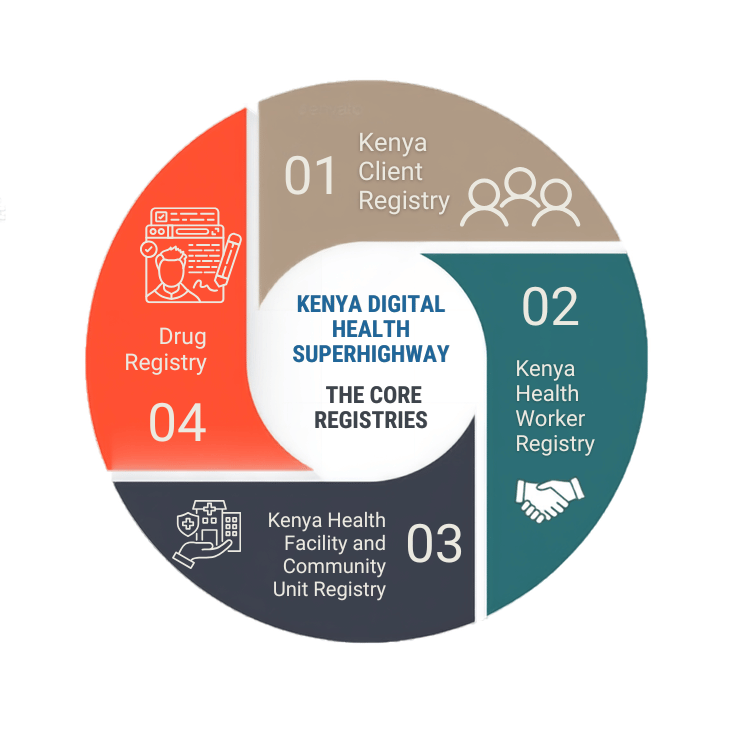
Before any system can share data reliably, it needs to answer a basic question: who is who? A patient named "John Kamau" at one hospital and "J. Kamau" at another might be the same person, or two different people. A drug called "Amoxicillin 500mg" might be coded differently in ten different hospital systems. Without standardized identities and codes, data sharing creates more problems than it solves.
DHA has solved this with four core registries.
Kenya Client Registry
The Kenya Client Registry is a centralized, authoritative database ensuring unique patient identification across the healthcare system. It generates and manages unique patient identifiers, maintains comprehensive demographic data with validation, and uses advanced search with deterministic and probabilistic matching.
In practice, this means every Kenyan patient has one unique health identity, recognized by every facility connected to the Superhighway. When a patient visits a new hospital, the system finds them. No duplicate records. No fragmented histories. One patient, one identity, everywhere.
Kenya Health Worker Registry
The Kenya Health Worker Registry is a sophisticated repository maintaining verified information about healthcare professionals, with verified credentials and specializations, role-based access control for HIE interactions, and integration with licensing platforms.
This registry ensures that when a prescription is issued or a procedure ordered, the prescribing clinician's credentials are verified and on record. It's the basis for accountable clinical practice in a connected system.
Kenya Health Facility and Community Unit Registry
The Kenya Health Facility and Community Unit Registry is a comprehensive database standardizing information about healthcare facilities and community units, with unique facility identifiers for precise tracking, detailed facility data including services and contact information, and high-performance search for emergency planning
When an ambulance needs to find the nearest facility with a functional ICU, or when SHA needs to verify that a claim comes from a licensed contracted provider, this registry is the source of truth.
Drug Registry
The Drug Registry provides comprehensive drug information management with unique alphanumeric drug codes for precise identification, mapping to NHDD, WHO, and SNOMED terminologies, and PPB registration codes and Kenya National Drug Formulary references.
This is why HMIS systems are now required to use national product catalogue codes. When every facility codes drugs the same way, the national system can track drug consumption, detect unusual prescribing patterns, flag supply gaps and detect fraud.
Layer Two: Health Information Services
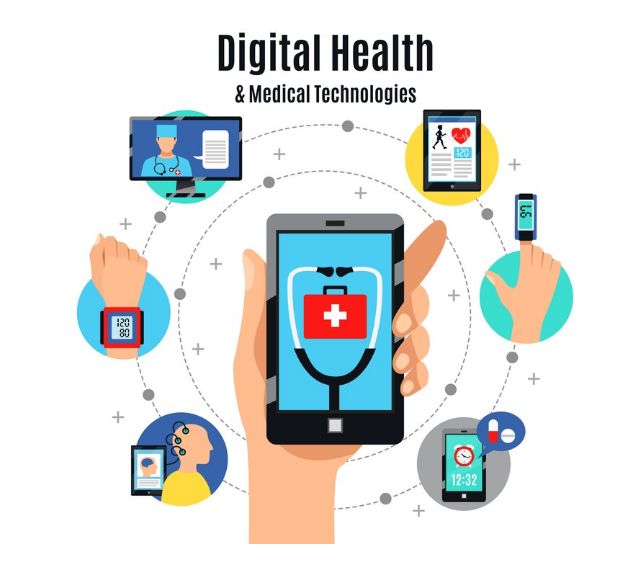
With registries establishing who is who, the Superhighway's second layer handles what happens when data actually moves between systems. This is the set of platforms that route, transform, and exchange health information across the national ecosystem.
The Health Information Exchange (HIE)
The Health Information Exchange is the backbone of Kenya's digital health ecosystem, a dynamic, standards-based platform facilitating secure and seamless data sharing among diverse healthcare systems. It is built on FHIR standards for real-time, bi-directional data exchange, hosts critical registries, provides advanced cybersecurity with encryption and role-based access, and integrates with national platforms including KEMSA and SHA.
Think of the Health Information Exchange (HIE) as the national network for sharing health information. It allows certified healthcare systems to securely send and receive patient data.
To connect to the HIE, systems must use the approved data standard (FHIR), meet the required security requirements, and exchange information only for authorized purposes. The HIE acts as the central platform that connects all the different components of Kenya's Digital Health Superhighway, allowing them to communicate and share information securely.
The Health Interoperability Services Layer (ISL)
The Health Interoperability Services Layer is the central coordinating hub enabling seamless data routing and transformation between health systems. It provides message routing to HIE components with a single access point, HL7/FHIR message transformation and orchestration, robust error management, and national-level scalability
The ISL is like the translator, it takes data from a hospital's HMIS, converts it into the national standard format, and routes it to the right destination. This is what makes it possible for systems built by different vendors, on different technology stacks, to communicate without breaking.
National Shared Health Record (SHR)
The National Shared Health Record is a centralized repository aggregating patient health data from multiple sources - EMRs, laboratories, pharmacies - using FHIR and SNOMED CT standardization, with role-based access and patient consent mechanisms, and real-time data retrieval for clinical decision-making
This is the component that most directly changes clinical care. When a patient presents at a facility connected to the Superhighway, the clinician can access that patient's shared health record, lab results from another facility, medications prescribed elsewhere, hospitalization history, chronic disease management notes.
Electronic Health Insurance Claims Platform
The Electronic Health Insurance Claims Platform revolutionizes claims processing for SHA with automated claim submission, tracking, and settlement, AI and ML-based fraud detection and risk scoring, real-time monitoring and analytics, secure payment gateway integration, and transparent claims processing workflows.
This is the system replacing the SHA Provider Portal. Claims no longer move through a manual web form, they flow automatically from the facility's HMIS through the HIE into the claims platform, where they are matched against clinical data, verified for authenticity, and processed. AI fraud detection runs on every claim.
Healthcare Licensing Platform
The Healthcare Licensing Platform streamlines the process of obtaining and renewing licenses for health professionals and facilities, with integration with medical boards and payment gateways, Single Sign-On and secure authentication, automated application verification and renewal processes, and enhanced regulatory oversight with audit trails.
Licensing, contract renewal, and regulatory compliance are moving onto the same connected infrastructure. For facilities, this means SHA contracting status, facility registration, and professional licensing will increasingly be verified through connected digital systems rather than manual document submission.
Layer Three: Patient-Facing Services What This Means for Your Patients
The Superhighway isn't just backend infrastructure. It has a patient-facing layer that changes how Kenyans interact with their own health data and the healthcare system.
Afya Yangu - The Patient Portal
The Patient Portal - Afya Yangu - is a secure, intuitive, and user-centric online platform designed to empower Kenyan citizens by placing them at the heart of the healthcare ecosystem. It enables self-registration and agent-based registration with biometric integration, appointment scheduling, bill payments, and prescription management, a robust consent management system for data control, SHA integration for insurance claims and pre-authorization, and multilingual support including Swahili.
A patient who visits your facility, and your facility is connected to the Superhighway, will be able to see their records from that visit on Afya Yangu. They can share those records with another provider with consent. They can manage their SHA insurance pre-authorizations. They can see their prescription history. The patient is no longer a passive recipient of care whose records stay trapped inside whichever facility they happen to visit.
National Telemedicine Platform
The National Telemedicine Platform empowers citizens with virtual access to healthcare services, bridging geographical barriers. It provides high-quality audio and video for seamless consultations, Patient Portal and HIE integration for real-time patient data, scalable and secure access, and enhanced care coordination with appointment management.
This platform connects directly to the patient's health record through the HIE, meaning a telemedicine consultation has access to the same clinical history as an in-person visit. Specialist consultations for patients in remote counties become clinically meaningful rather than guesswork.
Digital Quality Management
DHA's Digital Enterprise Quality Management Software is a centralized platform designed to elevate the quality of healthcare services, ensure compliance, and enhance patient satisfaction across Kenya's health facilities. It includes incident reporting, infection surveillance, audits and risk management modules, quality indicators and patient-reported outcome measures tracking, and AI-driven sentiment analysis.
Patient satisfaction scores, infection surveillance, and quality metrics are moving into the national digital infrastructure. For facilities seeking accreditation or trying to improve their SHA performance standing, this platform becomes the mechanism through which quality is measured and reported.
Layer Four: Digital Infrastructure - The Foundation Everything Runs On

DHA's digital health infrastructure provides a secure, scalable, high-performance network and cloud ecosystem, including software-defined WAN for PCN hubs, cellular connectivity using 4G and 5G for Level 2 and 3 facilities, Tier-3 data centers with redundant infrastructure, comprehensive cybersecurity with zero-trust access, and IoT devices, wearables, and telemedicine support.
This matters especially for facilities outside major urban centres. DHA has built connectivity infrastructure specifically designed for lower-level facilities - cellular connections for Level 2 and 3 hospitals that may not have fibre access.
DHA also operates centralized Security and Operations Centers - an SOC with real-time threat detection, a NOC for network infrastructure monitoring, and an ITOC with ticketing, automation, and reporting - providing 24/7 monitoring of systems and processes to quickly detect and resolve issues.
Layer Five: Intelligence - What Happens to the Data

One of the least-discussed but most consequential parts of the Superhighway is what happens to the data once it flows in.
Data Lake and Analytics Platform
DHA's Data Lake and Analytics Platform is a powerful solution for collecting, processing, and analyzing healthcare data for actionable insights. It includes data import and transformation, predictive analytics, NLP, and Auto-ML for over 20,000 variables, high-performance distributed processing, GDPR and HIPAA compliance, and interactive dashboards with automated reporting.
When 10,389 SHA-contracted health facilities are all sending structured, standardized clinical and administrative data into the national platform, the aggregated picture of Kenya's health becomes extraordinarily detailed. Disease patterns, drug consumption trends, facility performance, maternal health outcomes, chronic disease burden by county - all of it computable in real time.
This intelligence informs the Ministry of Health's policy decisions, SHA's payment models, county health budgets, and KEMSA's drug procurement. Facilities that contribute quality data to the Superhighway are shaping the decisions that ultimately determine what gets funded and where.
National Supply Chain Management
The National Logistics and Supply Chain Management System is a sophisticated platform managing medical supplies, reducing theft, and optimizing procurement and distribution. It uses blockchain-based track-and-trace for medicines, integrates ERP, tender, and order management platforms, and provides real-time supply chain transparency with national health systems integration.
Blockchain tracking of medicines means that every drug, from KEMSA's warehouse to the dispensing point at a health facility, has a verified chain of custody. Drug diversion and stock theft become detectable. Consumption data at facility level feeds back into national procurement planning so that stockouts become predictable and preventable.
National eLearning and Ambulance Platforms
DHA's National eLearning Platform is a virtual learning environment tailored for healthcare professionals, with adaptive learning, gamification, case-based scenarios, mobile responsiveness with multilingual support, and HIE integration for workforce management analytics.
The National Ambulance Service Platform provides real-time ambulance tracking and dispatching, HIE integration for patient data during emergencies, priority-based routing for urgent cases, and analytics for operational efficiency optimization.
When an ambulance is dispatched, it can pull the patient's health record en route. When it arrives at a facility, the receiving team has clinical context before the patient comes through the door. This is the kind of integration that saves lives in time-critical emergencies.
What the Superhighway Means for Your Facility in Practice

Let's translate the architecture into daily operational reality for a hospital administrator or clinical director.
Your new patient registration connects to a national identity. When a patient registers at your facility, their unique ID links to the Kenya Client Registry. If they have been seen elsewhere, their prior history becomes accessible (with appropriate consent). You stop treating strangers and start treating people with a clinical record.
Your clinicians have a fuller picture. Lab results, prescriptions, and hospital notes from other connected facilities are accessible in real time through the Shared Health Record. Medication errors from unknown drug histories decrease. Duplicate tests reduce. Clinical decisions improve.
Your claims go through a completely different process. Instead of manual portal entry, your HMIS sends claims automatically through the HIE into SHA's Electronic Claims Platform. Claims are verified against clinical data at the point of submission. Clean claims pay faster. Fraudulent or unsupported claims are caught automatically, before they ever become a problem for your facility.
Your drug dispensing is tracked nationally. Every drug dispensed through a connected pharmacy is recorded against the national Drug Registry with a verified code. This protects you against being implicated in drug diversion you didn't know about and connects your consumption data to national procurement intelligence.
Your facility's performance becomes measurable. Quality indicators, patient-reported outcomes, and incident data feed into the national Quality Management platform. This gives you a national benchmark for your facility's performance, and gives SHA and the Ministry of Health an evidence base for performance-linked funding.