
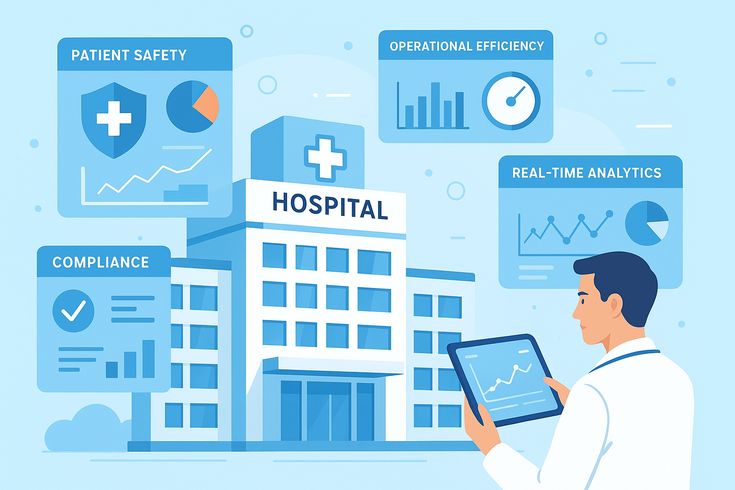
Hospital Software Explained: EHR, EMR, and Health Data Management for Modern Healthcare Facilities

Walk into most hospitals or clinics today, and you will find a mix of digital and analog still coexisting, running on a messy hybrid of paper charts, sticky notes, and three different software systems that refuse to talk to each other.
A patient's vitals might be typed into a computer. Their prescription might be handwritten. Their lab results might live in a separate system that doesn't talk to either. This isn't unusual, it's the current reality for a large share of healthcare facilities still transitioning toward fully digital operations.
If you are evaluating technology for your facility, you need to cut through the vendor jargon. Understanding the tools available is the first step toward making a good decision about your facility's technology. This guide walks through the core terms and concepts anyone evaluating hospital software should understand.
What Is Hospital Software?
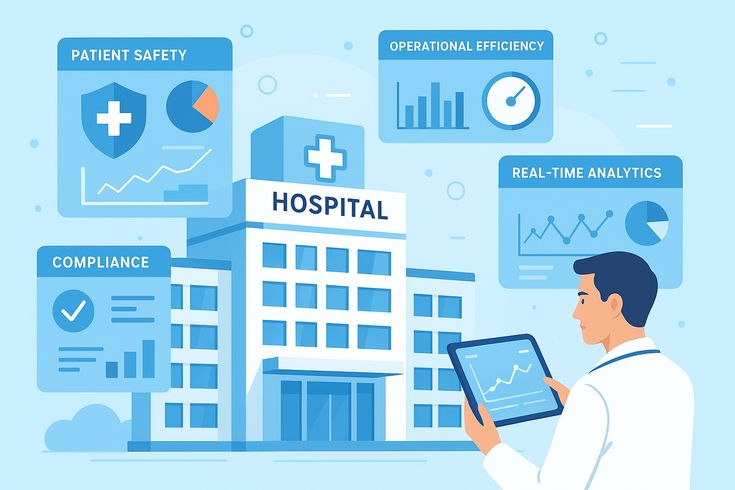
Hospital software is the digital nervous system of your facility. Hospital software is a broad term for any digital system used to manage the clinical, administrative, and financial operations of a healthcare facility. Depending on the size and scope of the facility, this might mean a single integrated platform or several specialized systems working together.
At its core, good hospital software handles the functions that used to live on paper: patient registration, clinical documentation, prescribing, billing, inventory, and reporting. But modern hospital software goes well beyond digitizing paper processes.
It connects departments that used to operate in isolation - so that when a nurse records a patient's vitals, the attending doctor sees them immediately; when a doctor prescribes a medication, the pharmacy sees the order without anyone walking a paper slip across the building; when a patient is billed, the charge reflects exactly what was delivered, because the billing system is reading directly from the clinical record.
The category includes several related but distinct types of systems, and understanding the differences between them matters
Electronic Health Records: The Foundation of Digital Care
Electronic health records (EHR) are the comprehensive, lifelong medical history of a patient. They are the digital version of a patient's complete medical history - diagnoses, treatments, medications, allergies, immunizations, lab results, and clinical notes - maintained over time and, ideally, shareable across the different providers involved in a patient's care.
An EHR is designed with the expectation that a patient's record might need to move - from a general practitioner to a specialist, from a clinic to a referral hospital, from one visit to the next years later. A well-implemented EHR means a patient's medical history follows them, rather than staying trapped in whichever facility first collected it.
A doctor who can see a patient's full history - previous diagnoses, known allergies, current medications - makes better decisions than one working from an incomplete picture pieced together from what the patient can remember to mention. Electronic health records reduce duplicate testing, catch dangerous drug interactions before they happen, and give continuity to care that would otherwise fragment every time a patient changes providers.
For healthcare systems moving toward national interoperability standards - as is happening across many African countries, including Kenya's move toward a connected national Health Information Exchange - a properly structured EHR is the foundation that makes that connectivity possible. Data that isn't captured in a structured, standardized electronic health record can't be shared reliably, no matter how good the national infrastructure around it is.
Understanding the Different EMR Systems on the Market
Here's where terminology often gets confused. Electronic Medical Records (EMR) are frequently used interchangeably with Electronic Health Records (EHR), but there is a meaningful distinction worth understanding.
An EMR is typically the digital chart used within a single practice or facility - the record of what happened during a patient's visits to that specific provider. An EHR, by contrast, is designed to be broader and interoperable - pulling together information across multiple providers and facilities into one longitudinal patient history.
In practice, many systems marketed as "EMR" today have evolved to include EHR-like interoperability features, and the line between the two has blurred. What matters more than the label is understanding what different EMR systems actually offer, because the market includes several distinct approaches:
Standalone EMR systems
It focus narrowly on clinical documentation - capturing consultation notes, diagnoses, and prescriptions - without necessarily integrating billing, inventory, or administrative functions. These tend to be simpler to implement but require separate systems for other hospital functions, creating the same data silos that digitization was supposed to eliminate.
Integrated hospital management systems with EMR built in
It combines clinical documentation with billing, pharmacy, laboratory, inventory, and administrative modules in one connected platform. This is generally the stronger long-term choice for any facility beyond a very small single-practitioner clinic, because it avoids the data fragmentation that comes from running multiple disconnected systems.
Cloud-based EMR systems
They run on remote servers accessed via the internet, reducing the need for expensive on-site infrastructure and making updates and maintenance simpler. This model has become increasingly popular in markets where reliable internet connectivity has improved and where facilities want to avoid the capital cost of maintaining their own servers.
On-premise EMR systems
They- run on servers physically located at the facility. These offer more direct control over data and can be preferable in settings with unreliable internet connectivity, though they typically require more in-house IT capacity to maintain.
Specialty-specific EMR systems
Built around the workflows of a particular type of care — maternity, dental, ophthalmology — offering deeper functionality for that specialty at the cost of broader hospital-wide integration.
Clinic Management System vs. Hospital Management System

A related distinction worth clarifying: not every healthcare facility needs the same scale of software.
A clinic management system is generally built for smaller-scale outpatient settings - a general practice, a dental clinic, a diagnostic centre - where the operational needs are narrower than a full hospital. Core functions typically include appointment scheduling, patient registration, basic clinical documentation, and billing. The complexity of inpatient bed management, surgical scheduling, or multi-department pharmacy and lab integration usually isn't necessary at this scale.
A full hospital management system, by contrast, needs to handle the operational complexity of inpatient care, multiple clinical departments, surgical theatres, laboratory and radiology integration, pharmacy and inventory management across departments, and often insurance claims processing at a much higher volume.
Choosing between the two is not just about facility size today, it is about growth trajectory. A clinic management system that can't scale into fuller hospital functionality becomes a limiting factor the moment a facility expands services, adds beds, or takes on more complex cases. Facilities planning to grow are often better served by a platform built with hospital-scale functionality from the start, configured to run lean for a smaller current footprint.
What Health Data Management Actually Involves
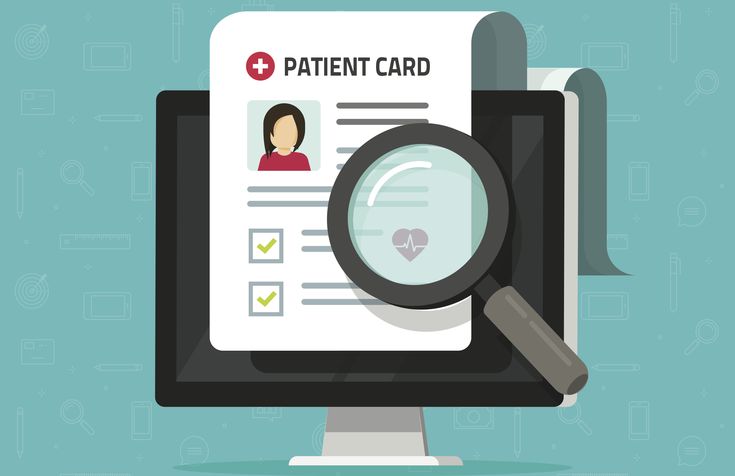
Health data management is the broader discipline of how a healthcare organization collects, stores, protects, organizes, and uses patient and operational data throughout its lifecycle. It is the overall practice and governance around data, of which software is one critical enabler.
Good health data management addresses several distinct concerns:
Data quality.
Information entered inconsistently, incompletely, or inaccurately undermines every downstream use of that data - clinical decisions, billing accuracy, and regulatory reporting all suffer when the underlying data is poor. Health data management practices include validation rules, standardized terminology, and structured data entry that reduce the errors that come from free-text, inconsistent record-keeping.
Data security and privacy.
Patient health information is among the most sensitive data any organization handles. Health data management includes access controls (who can see what), encryption, audit trails (who accessed what, and when), and compliance with data protection regulations - increasingly a legal requirement, not just good practice, as countries strengthen data protection laws governing health information specifically.
Data availability and continuity.
Data that exists but can't be accessed when needed - because of poor system design, downtime, or fragmentation across incompatible systems - fails the basic purpose of digitization. Effective health data management ensures data is available to the right people, at the right time, through reliable systems with proper backup and disaster recovery in place.
Data interoperability.
As national health systems increasingly move toward connected infrastructure, health data management includes ensuring that data captured at your facility can be understood and used by other systems - insurers, referral hospitals, national health databases - without manual re-entry or translation.
A hospital or clinic doesn't need to build all of this from scratch. Good hospital software should have strong health data management practices built into its design — but facility leadership still needs to understand these principles well enough to evaluate whether a given system actually delivers on them, rather than just claiming to.
Health Information Management and Medical Information Management: The Human Element
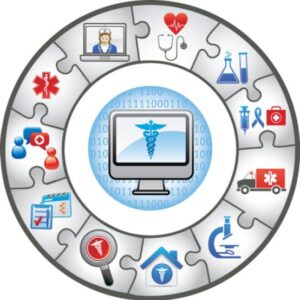
Software is only part of the picture. Health information management - sometimes called medical information management - is the professional discipline concerned with the accuracy, accessibility, security, and appropriate use of patient health information, encompassing both the technical systems and the human processes and policies around them.
It covers both the technology used to manage information and the human processes and policies that determine how that information is created, maintained, accessed, and shared.
This can include:
This matters because even the best hospital software fails to deliver value if the humans using it aren't trained to use it well, or if the facility hasn't established clear policies around data entry standards, access permissions, and information governance. A facility that invests in strong software but neglects this human and procedural layer will still end up with messy, unreliable data, just digitized instead of on paper.
Health information management professionals play an increasingly important role in healthcare facilities as digitization deepens. Their job is not just administrative; it's the quality control layer that ensures the promise of digital health data actually gets realized in practice.
Where This All Fits Into Digital Health
Digital health is the broader umbrella covering the use of digital technologies to improve healthcare delivery, health outcomes, and health system efficiency. It includes hospital software and EMR systems, but also telemedicine, mobile health applications, wearable health devices, health data analytics, and increasingly, artificial intelligence-powered clinical tools.
The individual pieces discussed in this guide from hospital software, EHR, different EMR systems, clinic management systems, health data management to health information management, are the foundational building blocks of digital health at the facility level. When these foundations are properly implemented, healthcare facilities are better positioned to participate in the broader digital health ecosystem.
Fragmented systems, poor data quality, and weak information governance can prevent a facility from taking full advantage of new digital health technologies, regardless of how much is invested in individual technology solutions.
What to Look for When Evaluating Hospital Software

Bringing this together into practical guidance, here's what matters most when evaluating hospital software, an EMR system, or a clinic management platform for your facility:
Integration over fragmentation.
A single connected system that handles clinical documentation, billing, pharmacy, and administration will almost always outperform several disconnected specialized tools, even if each individual tool is technically excellent, because the value of health data multiplies when it flows freely between departments.
Structured data over free text.
Systems that use standardized terminology, coded diagnoses, and structured data entry produce far more usable data than systems that rely heavily on free-text notes. This affects everything from clinical decision support to insurance claims accuracy to national health reporting.
Interoperability readiness.
As national digital health infrastructure matures across African healthcare markets, hospital software that isn't built for interoperability - data exchange standards, API connectivity, national terminology compliance - will become a limiting factor for facilities, regardless of how well it performs its core functions today.
Scalability.
Choose a system that can grow with the facility, rather than one that will need to be replaced the moment operations expand beyond its current scope.
Local support and training.
Health information management is a human discipline as much as a technical one. A vendor who provides genuine training, local support, and ongoing partnership will deliver more value over time than one who simply sells software and disappears after installation.
The Bottom Line
As digital health infrastructure continues to mature across African healthcare markets, facilities that understand these distinctions, and choose their technology and information practices accordingly, will be better positioned for what's coming: connected national health systems, AI-powered clinical support, and a standard of care that depends on data actually being usable, not just digitized.
MedicentreV3 HMIS, developed by Hanmak Technologies and deployed across 250+ health facilities in East and West Africa, is built around these principles - integrated clinical, billing, pharmacy, and administrative functionality in one connected platform, with structured data entry designed for the interoperability standards that Africa's evolving digital health infrastructure increasingly requires. MedicentreV3 handles what actually drains hospital money: SHA claims, eTIMS reconciliation, and drug billing that doesn't leak - all built-in.