
Kenya Is Building a Unified Language for Health Information, Here is Why That Matters

Imagine a patient is prescribed a common painkiller. At one hospital, the system records it as "Panadol." At another, it is entered as "Paracetamol 500mg Tablet." Same medication. Two completely different entries. Now that patient's record needs to move between those two facilities - for a an insurance claim, or a national health report. The system reading that record has no reliable way to know these are the same thing.
Multiply that single example across every drug, every diagnosis, every lab test, and every medical procedure - across more than 16,000 health facilities in Kenya, each historically running its own systems with its own internal conventions - and you start to see the scale of the problem Kenya's health sector has quietly lived with for years.
Healthcare is complex. Different hospitals, labs, pharmacies, and insurers often use different words, codes, or formats to describe the same thing. Without a common standard, this creates confusion, errors, and inefficiencies.
This is the exact problem the Kenya National Health Terminology Service (KNHTS) was built to solve.
What Is the Kenya National Health Terminology Service (KNHTS) and Why Does It Matter?
The Kenya National Health Terminology Service (KNHTS), built and managed by the Digital Health Agency (DHA), is essentially a universal translator for healthcare data.
It is a single, authoritative reference library that provides standardized healthcare terms, diagnosis codes, procedure codes, and other coded health data, meant to be used consistently across the Kenya Digital Health Superhighway.
The Terminology Service ensures data from Hospital A can be understood by Hospital B, that prescriptions created in one EMR are valid in another, that national and international reporting remains consistent, and that data stored in the Shared Health Record is standardized and accessible to any EMR or healthcare system.
Here is what that translates to in daily reality:
Consistency across systems.
"Panadol" equals "Paracetamol 500mg Tablet" across every connected system, reducing ambiguity and ensuring product consistency across EMRs. A referral note that says one thing at the sending hospital reads correctly at the receiving one, without a nurse having to guess or call to confirm.
Cleaner integration between clinical and financial data.
The standard connects clinical codes to billing, insurance claims, and supply chain identifiers, so a prescription of Paracetamol is linked to both its clinical code and its SKU in the pharmacy. This is directly relevant to SHA claims: a claim that references a standardized diagnosis and procedure code is verifiable against clinical documentation in a way that free-text entries never could be. Fewer disputes. Fewer rejected claims. Faster payment.
Better clinical decision support.
Standardized terminology powers Clinical Decision Support Systems for key decision-making. AI-driven prescription safety checks, drug interaction alerts, and diagnostic support tools all depend on data being coded consistently. A system can't flag a dangerous drug interaction if it doesn't reliably recognize that "Panadol" and "Paracetamol" are the same active ingredient.
Meaningful national reporting.
A national report on the number of antibiotics dispensed in a quarter only works if antibiotics are coded consistently across every contributing facility. Disease surveillance, drug utilization tracking, and resource planning at the Ministry of Health level all depend on this kind of aggregation working correctly, which it can't, without standardized terminology feeding in from every facility.
What KNHTS Actually Contains
KNHTS is not a single list. It's structured as a layered system, and understanding the structure helps clarify how it actually gets used
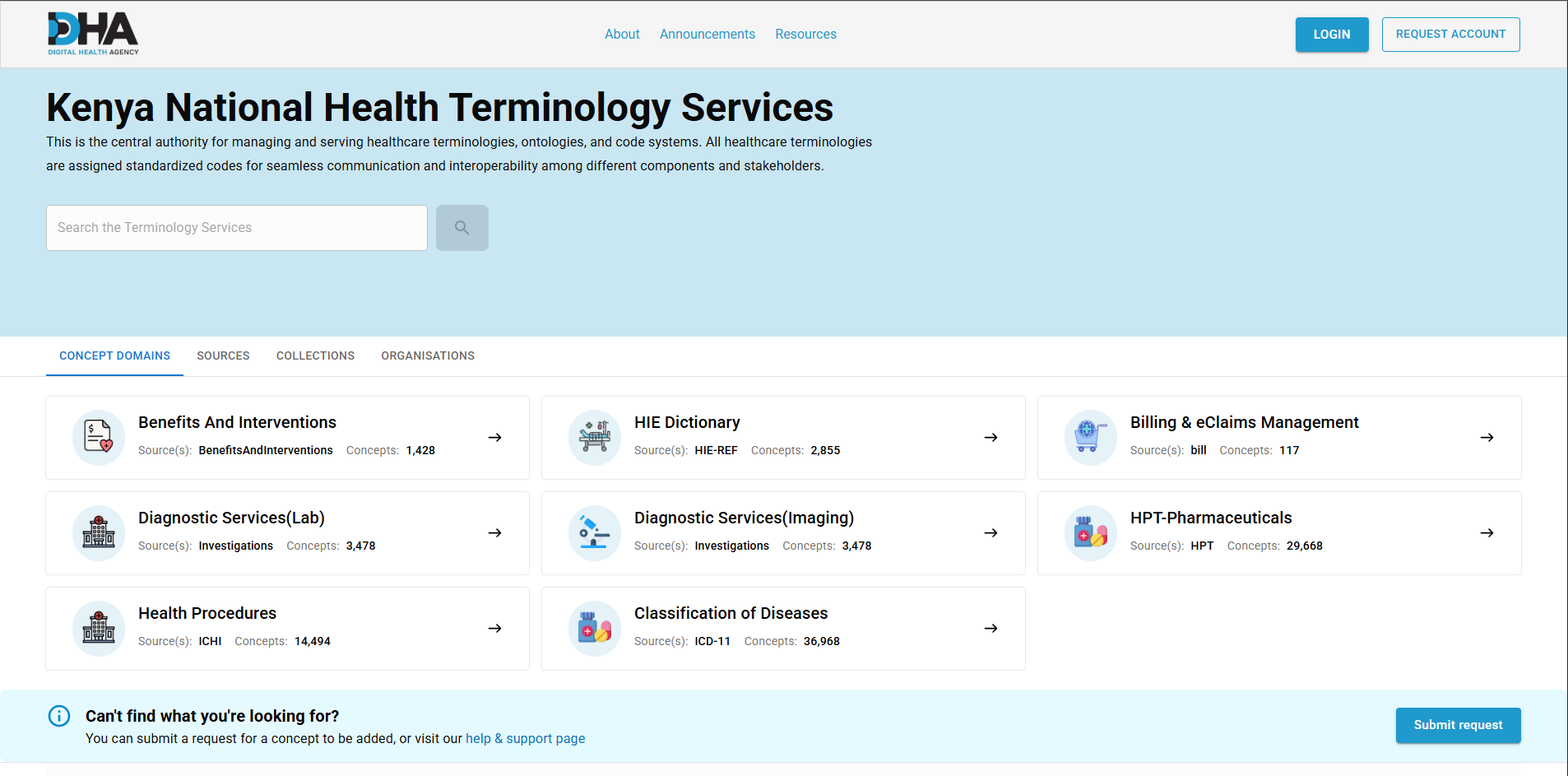
The core concepts within the Terminology Service are Organization, Source, Collection, and Concept.
An example hierarchy makes this concrete: Organization (Ministry of Health) → Source (National Drug Codes) → Collection (Antibiotics) → Concept (Amoxicillin 500mg Capsule).
This structure allows KNHTS to incorporate established international standards rather than reinventing them. The Terminology Service binds data to controlled vocabularies and code systems including ICD-11 for diseases and conditions, LOINC for lab tests, and ICHI for procedures. Kenya is not building its coding system in isolation, it is aligning with global standards while adding the local specificity (national drug codes, Kenya-specific health interventions) that a purely international standard wouldn't cover.
How KNHTS Fits Into the Bigger National System

The Terminology Service works alongside three other national registries: the Master Patient Index, which establishes who the patient is; the Health Worker Registry, which establishes who is providing the service; and the Facility Registry, which establishes where the service is happening. Together, these four components ensure trust, consistency, and accountability across the healthcare ecosystem
Patient identity, provider identity, facility identity, and clinical terminology are the four foundational pillars that any connected national health system needs before anything else can work reliably
What This Means for DHA Certification
Here is the part every health facility administrator and HMIS decision-maker needs to understand clearly: KNHTS compliance is not optional for any Hospital Management System seeking to connect to Kenya's national health infrastructure.
Under DHA certification requirements, every hospital management system seeking integration with the national Health Information Exchange must communicate using this shared terminology.
In practice, this means an HMIS needs to actively query KNHTS and map every local entry to a standardized concept. Your EMR might record "Panadol 500mg", but instead of storing that as free text, the system queries the Terminology Service and links it to the standardized concept "Paracetamol 500mg Oral Tablet" with its corresponding code. When this record is shared, other facilities recognize it correctly, even if their own local system displays it differently.
An HMIS vendor pursuing DHA certification needs to have built actual API connections to the Terminology Service, mapped their existing drug and diagnosis libraries to the standard codes, and validated that this mapping works correctly across real clinical workflows.
What Health Facilities Should Take Away From This

If you are evaluating an HMIS - whether you're renewing with a current vendor or considering a new one - this is a question worth asking directly: does your system integrate with the Kenya National Health Terminology Service, and can it demonstrate that integration?
This matters beyond compliance. A facility running a terminology-compliant HMIS gets cleaner claims processing, better clinical decision support, more reliable referral communication, and data that actually contributes meaningfully to national health reporting.