SHA HMIS Transition Explained: DHA Certification and SHA Integration for Kenyan Hospitals
If you run a hospital or clinic in Kenya and you keep hearing "HMIS," "DHA certified," "AfyaConnect" and "the portal is closing" without anyone explaining what it all means, this guide is for you. No prior knowledge needed.
The 60-second version
Why is this happening?
The Ministry of Health's stated reasons are practical. Health CS Aden Duale has said the new setup is meant to fix problems that faced the portal: delayed reimbursements, weak verification and claims fraud. An HMIS connected to SHA allows real-time patient verification, electronic claims processing and secure provider sign-in. It also means a patient's records and scans can be viewed across facilities without the patient having to carry them around.
There is a legal basis too. SHA is required under Regulation 64 of the Social Health Insurance (General) Regulations, 2024 to operate a single centralised digital platform for its processes. The Digital Health Act, 2023 and the 2025 regulations made under it set up the national health information system and require digital health solutions to be certified by DHA.
What is changing?
The transition is intended to move towards a more integrated digital health environment where the hospital's HMIS becomes the primary system through which healthcare services and related information are managed. This is part of the already ongoing rollout of the digital superhighway, and already paid for suite of SHA systems.
Instead of hospital staff having to enter or transfer the same information into different systems, the HMIS is designed to integrate and communicate with SHA and other relevant health-sector systems. The broader is simple: one hospital system that can securely communicate with the different systems supporting healthcare delivery.
This is consistent with the principle that a patient should not have to navigate multiple disconnected systems simply to receive healthcare services.
The two requirements, and why both matter
Think of a new phone. It has to be approved before it's allowed on the network, but approval alone doesn't mean your SIM card is active. DHA certification and SHA integration work the same way.
Requirement 1: Your HMIS must be DHA certified

Certification is DHA's check that your software is secure, protects patient data and can exchange information in the national format. DHA's 29 June 2026 presentation to providers set out what a software vendor must demonstrate:
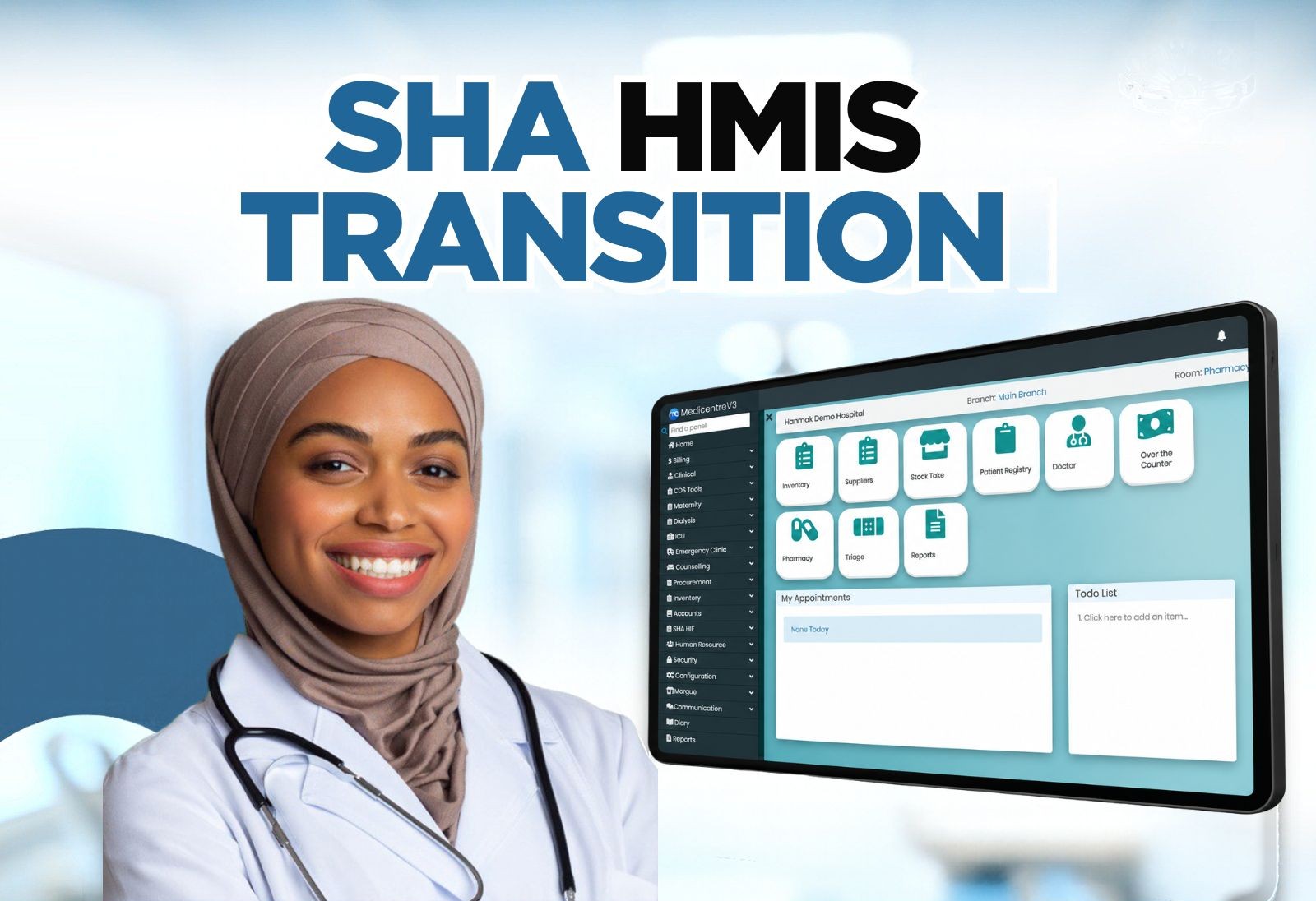
The process: the vendor assesses itself, applies online at certification.dha.go.ke, DHA reviews the documents and may test the system, and DHA notifies its decision. Certified systems are then listed on DHA's registry. MedicentreV3 HMIS is DHA certified aligning with the latest DHA requirements.
Requirement 2: Your HMIS must be integrated with SHA
Certification does not connect you to SHA. You need to be DHA certified to begin SHA integration process. That is a separate, step-by-step process through AfyaConnect. According to DHA's AfyaConnect developer guide, it goes like this:
The order is fixed. At the 29 June forum, the Ministry said an HMIS must first be certified by DHA before it can be integrated into the national platform.
What your facility should do now
1. Ask your vendor for proof of DHA certification, Don't accept "we're in the process" without a date.
2. Ask where they are on the AfyaConnect steps. Are they live with SHA? Are other facilities submitting real claims through them?
3. Complete your HAKIKA contract by 14 October. Use SHA's e-contracting portal at econtracting.sha.go.ke, and confirm your licence and bank details are correct. The HAKIKA contracts run will from 1 October 2026 to 30 June 2029 and are signed through SHA's e-contracting portal.
4. Name someone responsible for IT. The Ministry has told facilities to be fully licensed, have a certified HMIS, designate ICT support staff and prepare their teams.
5. Train your staff early. Moving to a new way of submitting claims takes more than installing software. Don't leave training to the last week of October.
6. Know who to call. DHA support: helpdesk@dha.go.ke. SHA toll-free: 147 (or 0800 720 601).
What happens if a facility doesn't comply
Where MedicentreV3 HMIS Stands on DHA Certification and SHA Integration
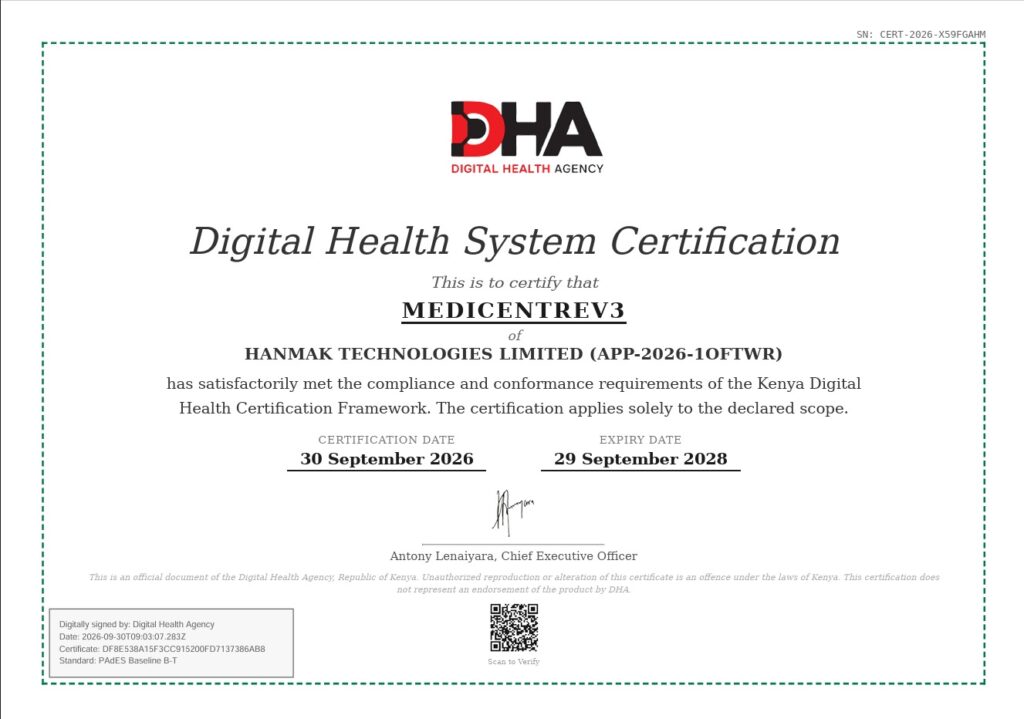
MedicentreV3 HMIS has successfully completed integration with the Social Health Authority (SHA) and has been fully certified by the Digital Health Agency. MedicentreV3 HMIS is the leading fully compliant HMIS solutions in Kenya aligned with the latest SHA and DHA requirements.
MedicentreV3 continues to bring together healthcare management functions within a single integrated platform, helping healthcare organizations manage their operations while supporting the broader digital transformation of healthcare. Our focus remains the same: build, improve, validate, and keep moving forward.
Don’t wait for the SHA portal to close before making sure your facility is ready. Choose an HMIS that combines DHA certification with SHA integration and the workflows your facility needs to keep serving patients with confidence. Get SHA-ready with MedicentreV3.